
Effects of food price hike on poverty and right to food and nutrition of the low-income people in Bangladesh
Abbreviations
BBS = Bangladesh Bureau of Statistics
BDT = Bangladeshi Taka
BER = Bangladesh Economic Review
BRAC = Bangladesh Rural Advancement Committee
CEDAW = The Convention on the Elimination of All Forms of Discrimination against Women
COVID-19 = Corona Virus Disease 2019
CRC = Convention on the Rights of the Child
DAE = Department of Agriculture Extension
DAM = Department of Agriculture Marketing
FAO = Food and Agriculture Organization
FIES = Food Insecurity Experience Scale
FY = Fiscal Year
GED = General Economic Division
GFSI = Global Food Security Index
HIES = Household Income and Expenditure Survey
HYV = High-Yielding Variety
ICESCR = International Covenant on Economic, Social, and Cultural Rights
IFAD = International Fund for Agricultural Development
mmt = million metric ton
MoA = Ministry of Agriculture
MoC = Ministry of Commerce
MoF = Ministry of Food
MoFL = Ministry of Fisheries and Livestock
OMS = Open Market Sales
RAI = Responsible Investment in Agriculture
RtFG = Right to Food guideline
RTFN = Right to Food and Nutrition
SDG = Sustainable Development Goal
TCB = Trading Corporation of Bangladesh
UN = United Nations
UNHRC= United Nations Human Rights Council
UNICEF = United Nations International Children’s Emergency Fund
UPR = Universal Periodic Review
USA = United States of America
VGGT = Voluntary guidelines on the responsible governance of tenure of land, fisheries and forests
WB = World Bank
WFP = World Food Programme
Contents
| List of Figures & Tables | 4 |
| 1. Executive Summary ……………………………… | 5 |
| 2. Objectives of the Study …………………………………………… | 6 |
| 3. Introduction ………………………………………………….. | 7 |
| 4. Methodology of the Study..……………………………………… | 8 |
| 5. Key Findings of the Survey ………………………..……………… | 9 |
| 5.1 Occupational status of the respondents | 9 |
| 5.2 Income status of the HH | 9 |
| 5.3 Food purchasing power | 10 |
| 5.4 HH level food expenditure | 11 |
| 5.5 Food security situation of the HH | 16 |
| 5.6 Access to OMS …….……………………………… | 17 |
| 5.7 Responsibility of the Government ………………………… | 18 |
| 6. Food Security Situation in Bangladesh …………………… | 19 |
| 7. Food Price Hike and Food Security ………………………… | 20 |
| 7.1 Pillar-1: Food Availability …………………………………… | 20 |
| 7.2 Pillar-2: Food Accessibility …………………………………… | 22 |
| 7.3 Pillar-3: Food Utilization …………………………………… | 23 |
| 7.4 Pillar-4: Food Stability …………………………………… | 23 |
| 8. Recent Price Hike in Bangladesh …………………………… | 24 |
| 9. The Causes of Food Price Hike ………………………………… | 26 |
| 10. Effects of Food Price Hike ………………………………… | 27 |
| 11. Emerging Challenges in Ensuring RTFN ………………………… | 29 |
| 12. Conclusions ………………………………………………… | 29 |
| 13. Recommendations ………………………………………… | 30 |
List of Figures & Tables
Figures:
| Figure 1: Gender segregation of the respondents | 8 |
| Figure 2: The number of respondents against their occupation | 9 |
| Figure 3: The monthly household income of the respondents before and during the outbreak of the COVID-19 Pandemic in March 2020. | 10 |
| Figure 4: The % of respondents regarding the prices of essential food items that are beyond their purchasing power | 11 |
| Figure 5: Status of household food expenditure of the respondents | 11 |
| Figure 6: Share of income spent on purchasing food by the respondents’ households during the price hike | 12 |
| Figure 7: Increase in household food cost during the last month, October 2020 | 13 |
| Figure 8: % of respondents according to the food purchase during the price hike | 13 |
| Figure 9: % reduction of food cost due to price hike | 14 |
| Figure 10: % of respondents cut expenditures on other basic needs due to price hike | 15 |
| Figure 11: % of respondents cutting the basic need due to price hike | 15 |
| Figure 12: Status of borrowing money of the respondents | 16 |
| Figure 13: The status of the number of meals taken per day by the respondents | 16 |
| Figure 14: Status of food accessibility of the respondents | 17 |
| Figure 15: The foodstuffs purchased by the respondents from OMS | 17 |
| Figure 16: Respondents’ opinion regarding reasons for not buying from OMS | 18 |
| Figure 17: Respondents’ opinion regarding the responsibility of the government in ensuring food for the poor citizens | 19 |
| Figure 18: Changes in prices of Aman-HYV-Coarse rice during 2015-2020 | 24 |
| Figure 19: Monthly increase in the price of onion (local) in 2019 | 25 |
Table:
| Table-1: Food grain production & requirement in Bangladesh | 21 |
1. Executive Summary
The price spike of essential foodstuffs exists as a dominant and unsolvable problem in Bangladesh decade after decade. Continuous, unprecedented, and excessive rise in the price level of essential foodstuffs is highly detrimental, especially to the low-income[2] poor people for their socio-economic interest, both in terms of current well-being and future economic development. The real disposable personal income of the poor household and consequently their spending capacity are significantly affected by the shock of the price hike.
The present study was undertaken to understand the effects of price hike on ‘RTFN’ of the low-income people of Bangladesh as well as reveal the root causes of such price hike and find out the possible solutions
A total of 438 poor people of 24 low-income professional groups from 19 districts of Bangladesh were randomly interviewed by using the Survey Monkey Tool to collect primary data for this study. The secondary data were analysed, and a good number of literature were reviewed for understanding the trend, root causes, and solutions of the problem of price hike.
The survey data shows that the monthly family income of 24% of the respondents were below BDT 3,000 which was 4% before the COVID-19 pandemic while only 1% of the respondents had an income higher than BDT 10,000 which was 27% before the pandemic that indicate their level of income much below of the national per capita average income (BDT 15,988; HIES, 2016). The family income of the rest of the respondents (69%) ranged between BDT3,000 and BDT10,000.
The respondents of the study noticed that the prices of almost all of the major food items went beyond their purchasing power since the middle of the year 2020, when the economic shock of COVID-19 also caused a drastic reduction in their income. During the previous three months of the survey, among the staple and most essential foodstuffs such as Rice, Onion, Potato, and vegetables went beyond their purchasing power as opined by 86%, 94%, 91% and 81% of the respondents, respectively. On the other hand, 62% of the respondents had an opinion that the prices of Dal viz. Lentil, Mung bean, etc., and 55% of the respondents opined that the other food items, such as fish, meat, egg, milk, which are the major sources of protein for the poor people, were also too high to afford by them. In such a situation, only 5% of the respondents could manage to purchase the same amount of food that they could purchase before the price hike, while the rest 95% of the respondents had to purchase a little less (32%) and much less (63%) amount compared to the normal price situation.
About 99% of the respondents opined that they had to cut expenditures for other basic needs either often (65%) or sometimes (34%) due to the price hike. Most of the households had to adjust their increased food cost by cutting the cost of other basic needs such as clothing (77%), treatment cost (56%), education cost (40%), and other costs (73%).
In order to meet the extra expenditures for food due to price hike, the households often have to take a loan from microcredit NGOs or local money lenders at a high rate of interest. It was found from the survey that 52% of the households had to take a loan during the last month, maybe due to the price hike. The average amount of loan was BDT22,076, which ranged between BDT3,500 and BDT50,000. Thus, the food price hike throws the poor people under a huge burden of debt.
About 93% of the respondents said that they could afford three meals a day before the price hike, which has been reduced to 60% due to the price hike. On the contrary, before the price hike, only 5% of the respondents used to take two meals a day, which was increased to 40% due to the price hike. About 35% of the respondents reported having to go a day without food sometimes, while 20% stated that they often had to spend a day with an empty stomach, indicating their worst situation in terms of food accessibility.
Open Market Sale (OMS) run by the TCB seems to be a major instrument for the government in managing food accessibility for the poor people as well as to control the price hike. But from the survey it was frustratingly found that 78% of the respondents didn’t buy any food from OMS within previous one month of the study despite running of the OMS at that time that indicates the lower effectiveness of the OMS service in ensuring benefit of the program for the poor people.
In response to the query of the reasons for not buying food from OMS, the highest 25% of the respondents said that they didn’t know the place where the OMS sales take place, while the second highest 21% of the respondents said that the supply in the OMS was not adequate compared to the demand, so food was not available to them.
As per the analysis in this study, major causes for the of unprecedented price hike in Bangladesh are unpredictable production loss due to the natural disasters; creation of artificial supply scarcity by the traders; the failure of market regulatory bodies due to lack of enough capacity & policy instruments, corruption or other vested interest; lack of authentic demand and supply data to prepare appropriate production and import plan; panic purchase by the consumers etc.
Formation of price commission, strengthening the capacity of TCB, Efficient supply management by managing domestic production and import and strengthening coordination mechanism among the relevant government institutions are necessary for keeping the prices stable while rationing of essential food stuff for the poor could be a good option to increase access to food for the poor not only for the price hike period but also ensuring the realization of their RTFN sustainably.
But, it is interesting to note that though too small but still 2% of the respondents opined that there is no responsibility of the government in combating food scarcity and price hike while 19% of the respondents do not know whether the government has any role to play though the government is constitutionally responsible for ensuring the food for all as basic need of every citizen. Therefore, the government seems to handle such a crucial issue of price hike in a very relaxed mode, as there is no legal obligation in the absence of a right to food law in Bangladesh to respect, protect and fulfill such an important basic human right of the people in general and poor & hungry people in particular.
2. Objective of the Study
The objectives of the study can be defined as follows in a broader aspect-
- To analyze the immediate impacts of the food price hike on the food and nutrition security of the low-income group of Bangladesh.
- To provide recommendations to the Governments to ensure food and nutrition security and share the same with civil society institutions.
3. Introduction
The right to food and nutrition (hereafter RTFN) is a basic human right which is recognized in an array of several international human rights instruments, e.g. Article 11 of the International Covenant on Economic, Social, and Cultural Rights (ICESCR), Article 6 of the International Covenant on Civil and Political Rights, Article 12 and 14 of the CEDAW, as well as Article 24 and 27 of the Convention on the Rights of the Child (CRC). Bangladesh has ratified all these instruments, and the government of Bangladesh is thus obliged under international law to respect, protect, and fulfill the RTFN. With the 2030 Agenda for Sustainable Development, adopted by all United Nations Member States in 2015, global leaders have committed to the goal of achieving zero hunger by 2030.
Food price hike drastically retard the rapid achievements in poverty alleviation and reducing hunger. A continuous, unprecedented, and excessive rise in the price level of essential foodstuffs is highly detrimental, especially to the low-income poor people, for their socio-economic interest, both in terms of current well-being and future economic development. The real disposable personal income of the poor household and consequently their spending capacity are significantly affected by the shock of price hike.
It is a matter of great concern that the cost of food crop production is being increased day by day, resulting in either an increase in food cost for the consumers or a decrease in profit margin for the producers, which is a great threat to the sustainability of food production and the stability pillar of food security. It will definitely hamper the achievement of other pillars like availability & accessibility as well.
Bangladesh is a country that is hit by various kinds of natural and man-made disasters almost every year. In 2020, the country has already experienced three big such disasters, namely the COVID-19 pandemic, Cyclone Amphan, and Severe Flood, one after another. The disasters have severely affected the life and livelihood of the poor people, resulting in a drastic decrease in the level of income that has made their life and food security situation perhaps the worst of recent times. In such a situation, a food price hike has emerged as a new disaster for the country, especially for the poor people. The poor people of the country are ruined by the natural and manmade disasters one after another, where price hike is perhaps the most vital one that severely affects the ‘RTFN’ of the poor people.
This quick study has conducted in order to figure out the causes, impacts and the possible solutions of price hike in Bangladesh in order to way out how to reduce the sufferings of the poor people and improving their food security situation with a view to drawing the attention of the state machinery in realizing the necessity of a legal framework for respecting, protecting and fulfilling the ‘RTFN’ of poor people of Bangladesh.
4. Methodology of the Study
A quick survey was conducted by using the “Survey Monkey” tool as well, and secondary data were collected, and a good number of literature were reviewed for collecting necessary data and information for the study.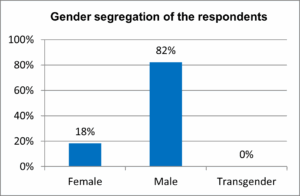
A total of 428 respondents from 19 districts of Bangladesh, almost an equal number from each district, were interviewed by the volunteer interviewer to fill up the questionnaire at survey monkey tool. Among the respondents, 82% were male and 18% were female (Figure 1). The low percentage of women respondents indicates the dominance of males in the low-income working class, while women are mainly engaged in professions like maidservants or unpaid household work. Because, in the Bangladesh context, women are mainly subordinate to men in the HH, doing mainly unpaid household work or engaged in a few special professions like garment workers. The men or women engaged in institutional labour were not considered for the study; rather, the daily wage earners were mainly considered.
The respondents were selected randomly, considering their professions representing 24 professional groups which are well-known to be low-income group because their monthly HH income is much below the national average HH income of BDT 15,988 (HIES, 2016). The respondents were categorized as extremely-low-income (> Tk 3,000), low-income (>Tk 3,001-5,000), lower-middle-income (Tk 5,001-7,000), upper-middle-income (>Tk 7,001-10,000) upper-income (> Tk 10,000). The districts covered by the study were Dhaka, Khulna, Chuadanga, Jhenaidah, Magura, Bagerhat, Satkhira, Chattagram, Khagrachari, Bandarban, Noakhali, Barishal, Pirojpur, Barguna, Mymensingh, Rangpur, Rajshahi, Sylhet, and Sunamganj, covering all 8 administrative divisions of Bangladesh. In order to get the target respondents, the data were collected mainly from urban areas, while the farmers and agricultural labourers were interviewed at the rural level.
Data also collected & analysed from the secondary sources to know the food availability, accessibility, utilization and stability situation in line with the aspects of RTFN while a good number of literatures were reviewed to understand the dynamics of food price hike, the root causes as well as to way out for the possible solutions to recommend to the state for their progressive realization of RTFN of the poor people of Bangladesh in absence of a Right to Food law in the country.
5. Food Security Situation in Bangladesh
Ensuring food security for all the people is a great concern for the agriculture of country. In Bangladesh, despite some impressive gains in recent years in terms of the availability of food grains, there remain several concerns. About 40 million people – one quarter of the population – remain food insecure, and 11 million suffer from acute hunger. Stunting – a condition induced by poor nutrition, with negative effects on a child’s physical growth and cognitive development – affects 36 percent of children under 5, with peaks of 50 percent among the poorest and those living in slums. In total, 5.5 million children under 5 are chronically malnourished (WFP, 2020[3]).
In 2019, the Intelligence Unit of the Economist Group conducted a study on the core issues of affordability, availability, and quality of nutritious food to all by calculating the data of 113 countries and prepared the Global Food Security Index (GFSI)-2019[4]. In the index, Bangladesh ranked 83rd (Score 53.2 out of 100) among 113 countries, which is the lowest among South Asian countries. In the index, Sri Lanka ranked 66th worldwide and first in South Asia with a score of 60.8, followed by India at 72nd (score 58.9), Pakistan at 78th (score 56.8), and Nepal at 79th (score 56.4).
The GFSI also scored and ranked the food security pillars, such as affordability, availability, and quality & safety, where the scores of Bangladesh are also the lowest among the five South Asian countries, where Bangladesh (77th; score 60.4) is little ahead of Nepal only (80th; score 58.5) in the food affordability indicator of the index. In the food availability indicator, Bangladesh scored 54.8 (79th), which is moderate, while the country scored very poorly in the food quality & safety indicator, which is only 30.6 and ranked 107th among 113 countries.
6. Price Hike and Food Security
6.1 Pillar-1: Food availability
In Bangladesh, food availability is almost synonymous to food grain availability, particularly the availability of rice. So, Bangladesh is claimed to be self-sufficient in food production since 2005, mainly because of the increased production of rice compared to the requirement, though the country seems to be surplus in food grains for few more years back. The claim is also supported by production and requirement data of food grain (rice and wheat only) as presented in Table 1. But, it is quite surprising to see from the table-1 that the import of food grains is increasing in a proportionate trend to the increase of production and the import went to a peak of 9.65 million metric tons in the FY 2017-18 when there was a bumper domestic production of 37.38 million metric tons which is slight below of the highest record of the production (37.41 mmt) in 2018-19.
It is worth mentioning here that for this study, it was very difficult to get sufficient ready secondary data on food requirement in Bangladesh which was then calculated by the author by using the available data from different sources, like the Household Income and Expenditure Survey (HIES) conducted by Bangladesh Bureau of Statistics (BBS), and the World Bank’s population data of Bangladesh.
Unexpectedly, no known and updated demand estimation exercises are done by the government for most of the food Items in Bangladesh, except for rice. Even for rice, there is serious doubt on the authenticity of the data. In the absence of correct information on the demand and supply of food items, a reliable price can simply not be predicted for any economy. Under such circumstances, the possibility of market imperfection through manipulation and adoption of unfair means cannot be ruled out (Islam, N, and Mukta ZH, 2011[5]).
However, the data presented in Table 1 shows that every year since 2000, Bangladesh has had a substantial amount of surplus of food grains (other minor food grains were taken into account except rice and wheat). But, still the experts say that there are apprehensions about the production of Bangladesh’s main food grain, rice, because when disaster strikes, around 2 to 5 per cent of the crops are destroyed and a food shortage emerges.
Note: The net availability of food grain has been calculated by deducting 12% due to wastage, use as animal feed & seed, etc. HIES 1995, 2000, 2005, 2010 & 2016 of BBS and World Bank’s population data have been used to calculate the food grain requirement. The food grain requirement per capita/day was taken from HIES as estimated 495g, 475.78g, 451.72g, 442.1g, and 387g/person/day in the year 1995, 2000, 2005, 2010, and 2016 and onwards, respectively.
In the 2007 cyclone Sidr, there was a 2 million metric tons shortfall of rice. In 2017, the sudden floods in Haor led to a 600,000 to 1 million shortfall in rice production. In both those years, the price of rice shot up, and Bangladesh was on the list of countries at food risk.
The second main food grain consumed in the country is wheat, and this is mainly imported. The annual wheat production in the country is 1 million metric tons in 2018-19, while the import was 5.5 million metric tons in the same year (BER, 2020[9]). Over the past two years, the fungal disease blast has seen a fast decrease in production, though people have changed their food habits and are turning more towards bread and wheat.
However, the figures presented in Table 1 bring several vital questions in front.
Firstly, why is Bangladesh importing an increasing amount of food grains every year?
Secondly, why is the availability of food always a panic in the country, which went to a peak during 2008, while the supply of food grain in the same year was a surplus of 11.8 million metric tons?
Thirdly, why have consumers been suffering a lot due to the reckless price hike of food grains for many years, when the government seems to be helpless to control the price?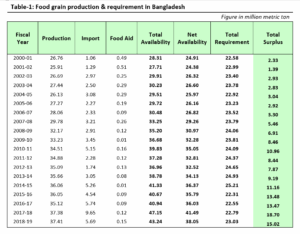
Fourthly, why is the government so eager to boost the production of food grain by any means, like promoting hybrid varieties that require more poisonous chemicals? and
Fifthly, why at least 20.5% poor people of the country can’t poor people afford the minimum food for their dietary requirements?
The answer lies within the unjust distribution system of food prevailing in the country, aggravated by the so-called free market economy controlled by the traders & corporations for their unfair greed of maximizing profit. Therefore, it is undoubtedly true that only ensuring a sufficient supply of food can’t ensure ‘RTFN’, which is also recognized by the WB study. But interestingly, the global policy institutions like the WB are looking for a solution to this problem by increasing the purchasing power of the people, though the struggle of consumers is quite often observed when there is even an adequate supply of food in the market. Therefore, for a better understanding of our ‘RTFN’ constraints, both the global and domestic market mechanisms and the hidden agenda of the market players need to be fully realized.
6.2 Pillar-2: Food Accessibility
It has already been discussed above that only the availability cannot ensure access to food. The food accessibility or affordability, along with other determinants, is directly related to the income or purchasing power of the people, coupled with a ridiculous food price hike aggravated by the greedy traders by creating an artificial crisis of food. As presented the income status of the survey respondents in the key findings section in Figure 2, the economic shock caused by the COVID-19 pandemic resulted in a drastic decline in the monthly household income of the poor people of Bangladesh. On the other hand, excessive price hike of most of the essential food items, which is partially caused by prolonged flood this year 2020, drastically retarded the accessibility of the food, especially for the poor people, which will definitely worsen the poverty and ‘RTFN’ situation of the country.
6.3 Pillar-3: Food Utilization
As discussed earlier in the Global Food Security Index (GFSI)-2019, Bangladesh scored very poorly in the food quality & safety pillar, which is only 30.6 out of 100, and ranked 107th among 113 countries. In Bangladesh, food quality and safety are a growing concern because millions of tons of agrichemicals are being poured into the fields to boost the yield of crops. Rampant use of antibiotics and other medicines is being used in producing poultry, cattle, and fish etc. Lots of poisonous chemicals like pesticides & preservatives are being used for the conservation and processing of food items. Moreover, rampant food adulteration as well as food processing & marketing in unhygienic conditions is also a grave concern for food safety. The foodstuffs that are specially consumed by the poor people are much more unsafe compared to the food taken by the rich people. The situation obviously deteriorates during the panic of price hike, when food adulteration also increases.
On the other hand, as far as nutrition status is concerned, the rice-based dietary pattern in Bangladesh causes severe food insecurity among the poor people. Nevertheless, the intake of energy and other essential nutrients is still far below the nutrient requirements and recommended dietary allowances, especially for the poor people of Bangladesh. Diets are largely imbalanced, with the staple food cereals contributing around 73% of total energy intake, a substantial proportion of dietary protein, and also the essential vitamins & minerals. In addition to imbalances in macronutrient intakes, diets are largely deficient in micronutrients, essential fatty acids, and individual amino acids. Partly as a consequence of the paucity of diets, there is a high prevalence of malnutrition, notably among young children and mothers, along with emerging problems of diet-related chronic diseases in the country as a whole and poor people in particular.
The food price hike essentially deteriorates the situation of nutrition security, especially for poor people, because more a reduction in dietary diversity. It is a fact that even in a normal price situation, the poor people have very limited access to diversified food such as fish, meat, egg, milk, or even dal, as well as fruits and vegetables in off-season, resulting in malnutrition or hidden hunger, which is severely deteriorated during the price hike situation.
6.4 Pillar-4: Food Stability
Price hike also affects the food stability very much in a country like Bangladesh. Unfortunately, in Bangladesh, food production totally depends on blind decisions of the farmers without having any proper pre-plan at the national level based on demand data, climatic forecasting, etc. Although the Department of Agriculture Extension (DAE) prepares an estimated target of crop production but it is never matched with farmers’ production plans. The farmers’ plan of production mostly depends on the market price of the commodity in the previous year. When the price of a particular commodity goes high and the farmers get the profitable prices of a particular crop in a certain year more farmers are encouraged to produce more in the subsequent year, resulting in excessive production and price fall. On the contrary, when the price of a particular crop falls and the farmers incur a loss, the farmers are discouraged from producing that crop in the subsequent year, resulting in less production and a price hike again. This is a very common market phenomenon of agricultural products, especially food products, which is one of the vital causes of instability in food production and food price volatility.
On the other hand, frequent natural disasters, climate-induced disasters, depletion of soil fertility status due to excessive use of chemical fertilizers, increased disease and insect infestation may be due to climate change, depletion of agricultural land, use of food grains as bio-fuel and animal feed, etc., are the major causes of food instability in Bangladesh. Such instability in domestic food production and supply significantly affects the food stability which severely affects the poor people very much.
7. Recent Food Price Hike in Bangladesh
The prices of most of the essential food items have risen to a peak during the last few months. The prices of rice, vegetables such as potatoes, eggplants, okra, spices such as green chilies, onion& garlic, and other essential commodities, such as sugar and eggs, increased in recent months. This, in turn, caused food inflation to go up as well.
However, in order to understand the situation of the recent price hike in Bangladesh, only the cases of coarse rice of HYV Aman varieties and onion are discussed below, just for example.
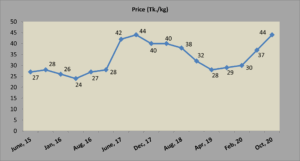 Looking at Figure 1, the monthly national average prices[10] of staple food rice of Aman-HYV-coarse varieties, which are especially consumed by the poor people, during the last five years, anyone can understand the instability and unusual hike of price in Bangladesh. The figure shows that in June 2015, the national average price of Aman-HYV-coarse rice was 27 Tk./kg, which was increased to a peak of 44Tk./kg in December 2017. The increase was 62% within a period of only one and a half years, which was then decreased to 28Tk./kg in April 2019 and again increased up to the peak 44Tk./kg in October 2020. The figure also shows that the price was more or less stable during the period of January 2016 to June 2017 and then a sharp increase is observed that remained high next more than one and a half years until August 2018.
Figure 1: Changes in prices of Aman-HYV-Coarse rice during 2015-2020; [Source: DAM, 2020]
On the other hand, the monthly national prices[11] of onion in 2019 and 2020 are presented in Figure 2. The figure shows that the price of onion was more or less stable between 45-50Tk/kg from January to June 2019, then a spiky increase is observed that reached to a peak (about 155Tk./kg) in November 2019 due mainly to the sudden export ban imposed by the India to Bangladesh despite the government’s declaration of enough domestic stock at that time. In fact, the actual retail price reached more than 200Tk./kg at that time.
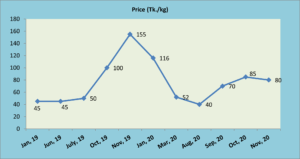
| Figure 2: Monthly increase of the price of onion (local) in 2019. [Source: DAM, 2020] |
It was massively reported by the media at that time that hoarding of onions by the traders was the main reason for such an unprecedented price hike. In spite of massive legal action taken by the administration against the illegal hoarding coupled with other actions like Open Market Sales (OMS) and easing import from other sources, the government was literally failed to control the price hike of onions at that time. The price was then started to decline after the domestic harvest of onion during February-March 2020 the price was declining to 40-45 Tk./kg up to August 2020, and then once again a sharp increase (80Tk./kg) is observed since September 2020. It is interesting to mention that the same thing was repeated in 2020 due to the export ban of onions once again by India to Bangladesh, said to be because of the domestic onion crisis in India, despite their promise to the government of Bangladesh to inform well-ahead of imposing such an export ban. Here, there is a strong public perception that the export ban was politically motivated in order to put pressure on the government of Bangladesh to support India in the regional geopolitical issues.
This is not a new case where food is often used as a political weapon. There is strong evidence that the famine of 1974 in Bangladesh was artificially created by a few global political forces, especially the USA, which is a burning example of evil political power game with newly born Bangladesh. The Nobel laureate economist Amartya Sen[12] also exposed the crude truth of such evil political games and exploitation that caused death of millions of people due to famine during the British rule in the Indian subcontinent. It is important to note that vested interest of the traders which is often supported by the political forces, is also one of the root causes of unpredictable and unethical price hike in Bangladesh and also in the world.
8. The Causes of Food Price Hike
The inconsistency between demand and supply is popularly considered to be the root cause of price instability or hike of any consumable good in the so-called free-market system. But, in the case of essential food items, the demands remain almost constant under any given situation. Therefore, changes in supply mainly determine the prices of essential foodstuffs.
Due to the natural disasters coupled with unethical behavior of the food traders, especially the illegal food hoarding for making huge profits, the prices of essential foodstuffs have been escalating day by day. It is well-known in Bangladesh that syndication among the food traders often creates an artificial crisis of food due mainly to illegal hoarding of foodstuffs and rapid spread of panic among the consumers, which stimulates the consumers to go for panic purchase. As a result, the prices go out of control of the market regulatory authorities. In such cases, we often observe that various actions taken by the regulatory bodies, even the legal actions, do not work at all, and finally, the government tends to say that they have nothing more to do in the free market economy. In fact, the government and the traders try to blame the free market system and the price volatility in the international food market. But, in such a blame game, very often it is surprisingly observed that the prices in Bangladesh don’t change in line with the changes in the international market, which indicates institutional failure.
However, the following could be the root causes of food price volatility and hikes in a country like Bangladesh.
- Unpredictable production loss due to the natural disasters along with post-harvest loss, food waste, etc., that cause food scarcity and food price volatility in both domestic and international markets.
- Creation of artificial & manipulated supply scarcity through illegal hoarding and creating panic by the traders for making unethical profit.
- Failure of market regulatory bodies due to a lack of capacity, policy instruments, corruption, or other vested interests.
- A sudden export ban by any exporting country may be due to domestic crises or diplomatic reasons.
- Lack of authentic demand and supply data to prepare an appropriate production and import plan.
- Blockage /disruption in the supply chain due to natural disasters, political unrest, vested political interest, etc.
- Panic purchase by the consumers when the rumor of a crisis is intentionally spread by the traders.
- Decrease of purchasing power due to economic shock or economic recession caused by a disaster like the COVID-19 pandemic.
- Use of food as a political weapon.
- Neoliberal trade policies imposed by organizations like the WTO in favour of companies and traders.
9. Effects of Food Price Hike on Poor People
The specific effects of the price hike on the RTFN of the low-income working class are already discussed in the “Key Finding of the Survey” section of the report based of the survey findings. It is important to note again that the study was conducted at a time when the economic shock of the COVID-19 pandemic had drastically reduced the purchasing power of poor people, rigorously hindering their accessibility to food.
It is already reported above that during the previous three months of the survey, among the staple and most essential foodstuffs such as Rice, Onion, Potato, and vegetables, went beyond their purchasing power as opined by 86%, 94%, 91% and 81% of the respondents, respectively. On the other hand, 62% of the respondents had an opinion that the prices of Dal viz. Lentil, Mung bean etc. and 55% of the respondents opined that the other food items such as fish, meat, egg, milk, which are the major sources of protein for the poor people, were also too high to afford by them.
As a result, 93% of the respondents said that they could take three meals a day before the price hike which was reduced to 60% due to the price hike. On the contrary, before the price hike only 5% of the respondents used to take two meals a day which was increased to 40% due to the price hike. It is very important to note that 35% of the respondents had to pass a day without any food “sometimes” while 20% of the respondents said that “often” they had to pass a day with an empty stomach, which indicates their situation of accessibility to food. Moreover, the respondents had to adjust with the crises by reducing their food purchases and/or cutting costs from other basic needs like education, clothing and even healthcare. However, the life of the low income and middle-income groups is affected very much because of the price hike of the essential food items. The consumers have either bound to cut their expenditures or borrow money to manage their extra expenditures due to the price hike.
However, in general, in a low-income, poverty-affected economy like Bangladesh, food price hike has enormous economic, social, cultural, and political impacts, particularly on the ‘RTFN’ and the livelihood of the poor people. Several studies have reported how the people of the country, particularly the low-income-earning groups and marginalized farmers, have suffered due to the food price spike. Similarly, the poverty level in the country might have increased as people’s income has not increased accordingly.
Recently in Bangladesh, the COVID-19 pandemic has posed a serious threat to ‘RTFN’ and nutrition because of the economic shock. Economic turmoil caused by the pandemic threatens both economic and physical access to food (FAO, 2019[13]). In Bangladesh, a nationwide survey conducted by BRAC (BRAC, 2020[14]) found that 93 percent of respondents have suffered a loss of earnings, with 54 percent reporting no income in March 2020. The study estimated a 60 percentage-point increase in extreme poverty (from 24 percent to 84 percent). Increased poverty of this magnitude will likely push many people into food insecurity in the short term. In the long term, attempts to cope with the economic shock will lead to lasting negative effect for many: family hardship will force children out of school; people will sell productive assets at low prices; children will lack nutritious food at critical growth stages of their lives (e.g. the first 1000 days).The price hike has come up as pouring water on a drowned mouse upon the life of the poor people of the country.
The Food and Agriculture Organization of the United Nations (FAO) estimates suggest a slow reducing trend in the prevalence of undernourishment in Bangladesh reaching 13.0% in 2017−2019. This reduction makes the General Economic Division (GED) target feasible although the COVID−19 crisis may dampen this progress. Indeed, it is expected that the crisis will reverse the gains made in nutrition improvement and impact the most vulnerable first and hardest. The COVID−19 crisis has made it clear that socio−economic inequality is a maker of malnutrition[15].
The prevalence of severe food insecurity based on the Food Insecurity Experience Scale (FIES) improved, down to 10.6% in 2017−19 from 11.6% in 2016−18. Following a slight decline, the three−year average for 2016−18 and 2017−19 has stagnated at 31.5% for moderate food insecurity, however. These figures are noticeably below the South Asia averages, which stand at 16.0% for severe food insecurity and 33.4% for moderate food insecurity over 2017−19, respectively. Food insecurity is likely to have worsened for the poorest, those on the brink of poverty, those heavily dependent on remittances, and daily rural labourers[16].
10. Key Findings of the Survey10.1 Occupation Status of the Respondents:
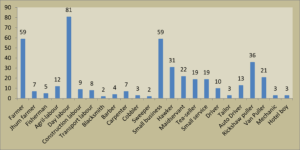
| Figure 2: The number of respondents against their occupation |
As mentioned in the methodology, the survey respondents were selected randomly, considering their low-income occupations as presented in Figure 2 below.
The occupations of the respondents were dominated by the farmer, day labour, the small businessmen, and rickshaw pullers as because they are the absolute majority among the low-income groups. The other professions were Jhum farmer, Fisherman, Agricultural labour, Construction labour, Transport labour, Blacksmith, Barber, Carpenter, Cobbler, Sweeper, Hawker, Maid servant, Tea-seller, Small service, Driver, Tailor, Auto Driver, Rickshaw puller, Van puller, Mechanic and Hotel boy etc.10.2 Income Status
As mentioned in the methodology, the survey respondents were selected from the low-income groups comprised of 19 respondents from extremely-low-income (>Tk.3,000) group, 78 from low-income (>Tk.3,001-5,000) group, 108 from lower-middle-income (Tk.5,001-7,000) group, 114 from upper-middle-income (>Tk.7,001-10,000) group and 119 from upper-income (>Tk.10,000). The overall family income of the respondents ranged between <3,000BDT to >BDT10,000 which is much below the national per capita average income(BDT 15,988; HIES, 2016) in the era when Bangladesh has already entered into the club of middle-income country club. Figure 3 shows that before the start of the economic shock caused by the outbreak of COVID-19 in Bangladesh in late March 2020 only 4% of the respondents had a monthly family income >3,000BDT, while 27% of the respondents’ family income was>10,000BDT. The family income of rest of the respondents (69%) ranged between BDT3,000-10,000.
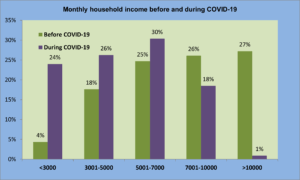
| Figure 3: The monthly household income of the respondents before and during the outbreak of the COVID-19 Pandemic in March 2020. |
It is apparent from the survey data presented in the figure that the income level of the participants is usually very low, which has drastically declined due to the economic shock of the COVID-19 pandemic. Before the outbreak of the COVID-19 pandemic, only 4% of the respondents had a monthly income <BDT3000, which has increased to 24% due to the economic shock of the pandemic. On the other hand, 27% of the respondents had a monthly income >BDT10,000, which is also reduced to 1% due to the same reason. The reduction in income level clearly indicates their reduced purchasing power of essential food items to meet their dietary need.10.3 Food Purchasing Power
The information presented in the figure-4, shows that almost all of the respondents opined that the price of the essential food items like rice, dal, onion, potato, vegetables, and also the other food items have gone beyond their purchasing power during the last few months since July 2020.
During the previous three months of the survey, among the staple and most essential foodstuffs such as Rice, Onion, Potato, and vegetables went beyond their purchasing power as opined by 86%, 94%, 91% and 81% of the respondents, respectively. On the other hand, 62% of the respondents had an opinion that the prices of Dal viz. Lentil, Mung bean, etc., and 55% of the respondents opined that the other food items, such as fish, meat, egg, milk, which are the major sources of protein for the poor people, were also too high to afford by them. It needs to be mentioned here that the prices of broiler chicken, commercially produced fishes, namely Pangas, Tilapia etc., went much down significantly since the lockdown of COVID-19 in March 2020 may be because of the diminishing purchasing power of poor people or the disruption of the supply chain.
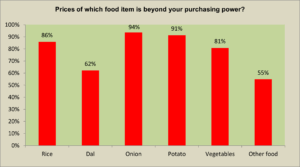
Figure 4: The % of respondents regarding the prices of essential food items that are beyond their purchasing power.
10.4. Household-Level Food Expenditure Situation
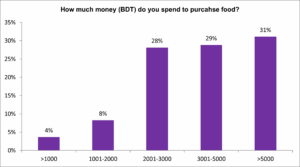
| Figure 5: Status of household food expenditure of the respondents. |
The household expenditure for purchasing foodstuffs of the respondents of the survey is presented in Figure 5. The figure shows that the highest 31% of the respondents had to spend more that BDT 5,000 for purchase of foodstuff while 29% and 28% of the respondent had to spend BDT 3001-5000 and BDT2001-3000 respectively while the present income status of the respondents as presented in figure-2 shows that monthly household income of 50% household is less than BDT5000 while the income of rest of the respondents ranged between the BDT5,000-10,000.
Therefore, taking the average income BDT5,000 and the average expenditure as BDT3,500 it can be said that the average family expenditure for food is approximately 70% of their monthly income while according to the HIES, 2016 about 60% of the household income is spent for the purchase of foodstuff.
The percentage of share of income spent for food purchase during price hike is presented in figure-6. The figure shows 38% of the respondents’ families had to spend more than 60% of their household income for foodstuff purchase while 11%, 16%, 15%, 13% and 7% of the respondents’ families opined that they had to spend 51-60%, 41-50%, 31-40%, 20-30% and <20% of their household income respectively.
It is therefore evident that a lion share of the income of the respondent had to spend for purchasing food staff which limit their expenditure for other basic human needs like clothing, health-water-sanitation, education, shelter and let alone the other basic human rights i.e., recreation.
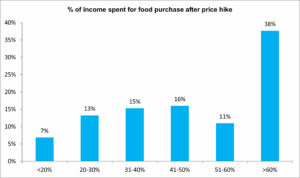
| Figure 6: Share of income spent on purchasing food by the respondents’ household during the price hike. |
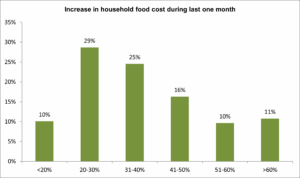
| Figure 7: Increase in household food cost during the last one month, October 2020 |
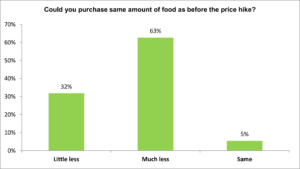
| Figure 8: % of respondents according to the food purchase during price hike. |
During the survey it was also tried to understand how much household food cost was increased in October 2020 (figure-7). According to the opinion of the respondents the household food cost significantly increased in October 2020 due to price hike. The figure shows that 11% of the respondents opined that their household level food cost was increased more than 60% in that month while 10% of the respondents reported <20% of the increase in food cost. The highest 20% respondents opined that their food cost was increased by 20-30% while 25% and 16% of the respondents reported the increase of food cost by 31-40% and 41-50% respectively.
Whatever may be the reason for instability in food market and sudden unusual price hike, it apparently compels the poor people to cut their spending for purchasing foodstuffs. The data presented in Figure 8 shows that during the period of price hike only 5% of the respondents could manage to purchase the same amount of food that they could purchase before the price hike while rest 95% of the respondents had to purchase little less (32%) and much less (63%) amount compared to the normal price situation.
The data presented in Figure 9 shows that maximum 41% of the respondent reduced their food cost by reducing the amount of food purchase by 30% due to the price hike while 26%, 19% and 10% of the respondents reduced the food purchase by >50%, 20% and 10% respectively. The data clearly indicates that due to price hike most of the respondent substantially reduced their food purchase which severely jeopardized the realization of the RTFN and hunger and malnutrition faced by many of the respondents.
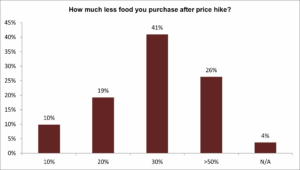
| Figure 9: % reduction of food cost due to price hike |
It is already seen that the households adjusted their food cost by reducing the amount of purchases. But, for the essential food items like rice, dal, potato, vegetables, spices etc., they had to buy them anyhow. In such cases, the households had to cut expenditures for other basic needs. In the survey, 99% of the respondents opined that they had to cut expenditures for other basic needs either often (65%) or sometimes (34%) while only 1% of the respondents had never to do that (Figure 10).
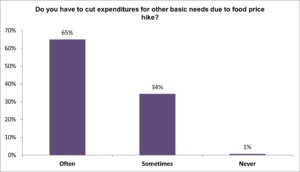
| Figure 10: % of respondents cut expenditures of other basic needs due to price hike. |
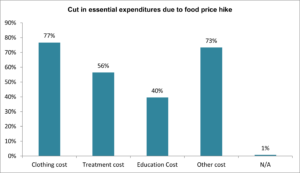
| Figure 11: % of respondents cutting the basic need due to price hike |
Figure 11 shows that most of the households had to adjust their increased food cost by cutting the cost of other basic needs, such as clothing (77%), treatment cost (56%), education cost (40%), and other costs (73%).
In order to meet the extra expenditures for food due to price hikes, the households often have to take a loan from microcredit NGOs or local money lenders at a high rate of interest. It was found from the survey that (figure-12) 52% of the households had to take a loan during the last month may be due to the price hike. The average amount of loan was BDT22,076, which ranged between BDT3,500 and BDT50,000. Thus, the food price hike throws the poor people under a huge burden of debt.
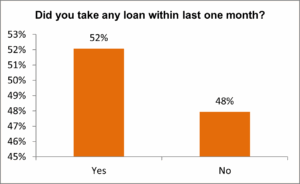
| Figure 12: Status of borrowing money of the respondents |
10.5 Food Security Situation of the Respondent Households
Food security is a complex phenomenon that is very difficult to determine through a rapid survey by using SurveyMonkey tools. However, it was still made to understand the food security situation of the household due to the price hike. For this few survey questions were set in line with the Food Insecurity Experience Scale (FIES) introduced by FAO. The findings of the survey in this regard are presented below.
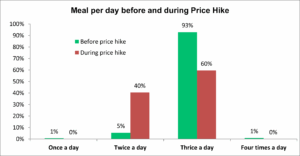
| Figure 13: The status of the number of meals taken per day by the respondents |
Figure 13 gives an interesting message on the change in eating habits of the respondents due to the price hike. The figure shows that 93% of the respondents said that they could take three meals a day before the price hike, which was reduced to 60% due to the price hike. On the contrary, before the price hike, only 5% of the respondents used to take two meals a day, which increased to 40% due to the price hike.
In response to the question “Did you pass a day without any food within the last month?” 46% of the respondents said “never” (Figure 14). It is very important to note that 35% of the respondents had to pass a day without any food “sometimes” while 20% of the respondents said that “often” they had to pass a day with an empty stomach, which indicates their situation of accessibility to food.
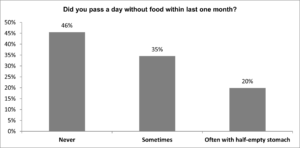
| Figure 14: Status of food accessibility of the respondents |
10.6 Access to OMS
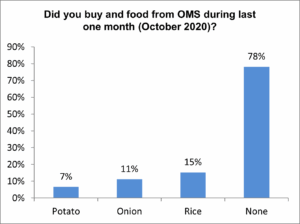
| Figure 15: The foodstuffs purchased by the respondents from OMS |
In order to increase access of the poor people to food as well as to stabilize the price hike the government often run “Open Market Sales (OMS)” programme. During the survey period, onions, rice, and potatoes etc., were sold as OMS by the Trading Corporation of Bangladesh (TCB). It was therefore, tried to know the experience of the respondents regarding OMS, which is presented in figure-15 & 16.
It is interesting to observe from the figures that 78% of the respondents didn’t buy any food from OMS during the last month, while only 15%, 11% and 7% of the respondents purchased rice, onion, and potato, respectively (Figure 15) which indicates the lower effectiveness of the OMS service of the government.
In response to the question of the reasons for not buying food from OMS as presented in figure-16, the highest 25% of the respondents said that they didn’t know the place where the OMS sales take place while the second highest 21% of the respondents said that the supply in the OMS was not adequate compared to the demand, so food was not available to them.
On the other hand, due mainly to inadequate supply compared to the demand, the people faced severe time constraints to purchase the food items from OMS because of very long queue. A good number of respondents (19%) said that it took longer time to purchase from the OMS while 12% of the respondent said that the sales point was too far from their residence to go there by affording travel cost and the required time. As because the respondents of the survey were from working class and depend on daily earning for their food, so they couldn’t afford to pay enough time to purchase the food from OMS.
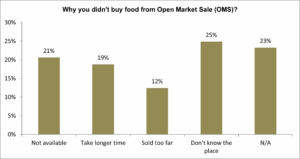
| Figure 16: Respondents’ opinion regarding reasons for not buying from OMS. |
10.7 Responsibility of the Government
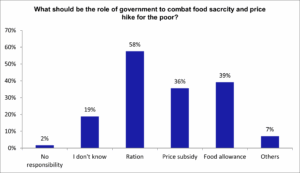
| Figure 17: Respondents’ opinion regarding the responsibility of the government in combating food scarcity and price hike. |
The respondents were asked for their opinion regarding the government’s responsibilities in combating food scarcity and price hike for the poor people 58% of the respondents opined for providing “ration service” for the poor, while 36% and 39% of the respondents opined for providing “price subsidy” and “food allowance” respectively (Figure 17). But, it is interesting to note that though too small but still 2% of the respondents opined that there is no responsibility of the government in combating food scarcity and price hike while 19% of the respondents do not know whether the government has any role to play though the government is constitutionally responsible for ensuring the food for all as basic need of every citizen. Therefore, the government seems to handle such a crucial issue of price hike in a very relaxed manner, as there is no legal obligation in the absence of a right to food law in Bangladesh to respect, protect, and fulfill such an important basic human right of the people in general and poor & hungry people in particular.
11. Emerging Challenges in Ensuring RTFN
However, according to a report on the ‘State of Food Security and Nutrition in the World 2020’ jointly prepared by FAO, IFAD, UNICEF, WFP and WHO, more than 820 million people in the world are hungry. Undernourishment is a problem not just in few selected countries, but worldwide. Despite an abundance of food availability, the index indicates that 10 percent or more of the population of more than a third of the countries is undernourished[17].
The report also says that the world is progressing neither towards SDG target 2.1, of ensuring access to safe, nutritious and sufficient food for all people all year round, nor towards target 2.2, of eradicating all forms of malnutrition. There are many threats to progress. The 2017 and 2018 editions of this report showed that conflict and climate variability and extremes undermine efforts to end hunger, food insecurity and malnutrition. In 2019, the report showed that economic slowdowns and downturns also undercut these efforts. In 2020, the COVID-19 pandemic, as well as unprecedented Desert Locust outbreaks in Eastern Africa, are obscuring economic prospects in ways no one could have anticipated, and the situation may only get worse if we do not act urgently and take unprecedented action.
12. Conclusion
RTFN is a complex, multi-dimensional issue. In order to guarantee RTFN now and in the future, countries need to ensure that food is affordable, sufficiently available for their population, and meets their dietary needs. In nearly one-quarter of countries, more than 20% of people fall below the global poverty line for lower-middle income countries[18].
As food is the basic human rights and the most basic thing for right to life which is recognized by the UN and also the constitution of Bangladesh and as because ensuring RTFN is a must for achieving the sustainable development goal of alleviating poverty and eliminating hunger, there is no other way but ensuring availability, accessibility, utilization and stability of food for all people. Most importantly, ensuring RTFN should be legal responsibility of any government to respect, protect and fulfill the right of every citizen of the country.
Bangladesh is still lagging far behind in ensuring RTFN of her population especially of them who are still can’t afford the minimum calorie intake to fulfill their nutritional requirements. Uncontrollable price hike coupled with unemployment & livelihood insecurity worsening the situation. Weak planning, policy instruments, management capacity and finally the lack of strong political will cause the failure of the state to fulfill such a constitutional responsibility which has to be improved in no time.
For doing this, enacting a ‘right to food law’ in line with the RtFG[19] of FAO, VGGT[20], and Responsible Investment in Agriculture and Food Systems (CFS-RAI[21] Principles) coupled with the CEDAW and ICESCR, is very essential for the country, which could guide the government to take appropriate steps in fulfilling the RTFN, especially for the low-income people of Bangladesh. The law must respect, protect, and fulfill the RTFN of the low-income people in every adverse situation, including price hike, as they are the most vulnerable to price volatility and any natural or man-made disasters, and it must be under the UPR[22] of the UNHRC. At the same time, the rights of the small-scale producers, who also represent the most vulnerable group, must also be protected by the national and global policy frameworks.
13. Recommendations
As the demands of essential foodstuffs are almost stable for a certain period, efficient management of supply is the key instrument for keeping the food price stable. Strong policy, along with institutional instruments and capacity, are much needed for the efficient supply management. Maintaining the food production and import to meet the domestic demands is very much important for efficient supply management. But, very unfortunately, the country doesn’t have sufficient reliable food production and requirement data. Moreover, the food production is very much dependent on climatic factors, which are rapidly changing due to climate change.
In order to maintain stable domestic production, ensuring profitable prices for the farmers, especially for the smallholder farmers, is a crying need for the purpose. In a certain year if the producers don’t get a profitable price of a food crop the production of that crop essentially decreases in the subsequent year or growing season. It is a good luck of the nation that the smallholder farmers continue their production despite being deprived of profitable prices for most of the crops. Agriculture is being more commercialized day by day, and farming is gradually going into the grip of big producers and corporations, which might be a great threat to the food sovereignty or RTFN of the poor people of the country, like Bangladesh.
In such a situation, the following measures could be taken to control food price hike in Bangladesh by ensuring RTFN of the poor and safeguarding small-scale food producers.
- Immediately formulate and enact a ‘right to food law’ in Bangladesh in line with the RtFG of FAO, VGGT, RAI in order to respect, protect and fulfill the RTFN security, especially for the poor people of the country what the country obliged to do according to the global treaties or policy frameworks like ICESCR, CEDAW and CRC which are already ratified by the country.
- Taking immediate measures to respect and strengthen traditional and indigenous food systems and a transition towards agro-ecological food systems for safeguarding small-scale food producers[23].
- Ensure profitable prices for the smallholder producers and supporting them to sustain in commercial agriculture in order to ensure a stable domestic production of essential food crops and protect their rights in line with SSF Guidelines[24] and CFS-RAI Principles[25].
- Rationing of essential food stuff like rice, onion, wheat, potato, oil etc. for the low-income groups.
- Improve capacity of BBS, DAM, DAE and other relevant government institutions in managing authentic data on food production, requirement and prices.
- Formation of price commission for efficient market monitoring.
- Strengthening the capacity of TCB in effective and efficient OMS of essential food products.
- Efficient forecasting on food production in the face of climate induced and natural disasters.
- Efficient management of import for maintaining domestic supply in line with the domestic requirement.
- Efficient forecasting on food prices in international market and taking necessary precautionary measures well ahead of the food crisis.
- Strengthening administration and law enforcing agencies with effective legal and policy instruments to control illegal hoarding and price hike.
Strengthening coordination mechanism among MoA, MoFL, MoFDM, MoC and other government institutions relevant to RTFN for better management of food production
[1] Agriculturist & Independent Researcher; email: shahid.bd1172@gmail.com
[2] Low-income group: The people having the monthly HH income lower than the national average HH income of BDT15,988 according to HIES, 2016 has been considered as low-income group for the study. The people who are mainly lives from hand to mouth, marginal farmers, low-paid labour, daily wage earners, floating people who earn from doing small business on the street, maid servant etc. especially living in the urban slums being migrated from the rural areas are considered as low-income group for the study.
[3] https://www.wfp.org/countries/bangladesh
[4] https://foodsecurityindex.eiu.com/index
[5] Islam, Nazrul A.K.M and Mukta, Ziaul Hoque, 2011: Institutional and Policy Failure Ignite Food Price Hike in Bangladesh; Campaign for Sustainable Rural Livelihood, September 2011.
[6]https://mof.portal.gov.bd/site/page/28ba57f5-59ff-4426-970a-bf014242179e/Bangladesh-Economic-Review-2020
[7] http://data.bbs.gov.bd/index.php/catalog/HIES
[8] https://data.worldbank.org/indicator/SP.POP.TOTL?locations=BD
[9] https://mof.portal.gov.bd/site/page/28ba57f5-59ff-4426-970a-bf014242179e/Bangladesh-Economic-Review-2020
[10] http://www.dam.gov.bd/
[11] http://www.dam.gov.bd/
[12] https://oxford.universitypressscholarship.com/view/10.1093/0198284632.001.0001/acprof-9780198284635; Poverty and Famines: An Essay on Entitlement and Deprivation by Amartya Sen.
[13] http://www.fao.org/2019-ncov/resources/policy-briefs/en/?page=5&tx_dynalist_pi1[par]=YToxOntzOjE6IkwiO3M6MToiMCI7fQ==
[14] BRAC, 2020. Rapid Perception Survey on COVID19 Awareness and Economic Impact. Dhaka, Bangladesh.
[15] http://www.fao.org/3/ca9692en/online/ca9692en.html
[16] http://www.fao.org/3/ca9692en/online/ca9692en.html
[17] https://www.who.int/publications/m/item/state-of-food-security-and-nutrition-in-the-world-2020.
[18] Global food security index 2019, an infographic by the economic intelligence unit of the economist.
[19] http://www.fao.org/docs/eims/upload/214344/RtFG_Eng_draft_03.pdf
[20] http://www.fao.org/cfs/home/activities/vggt/en/
[21] http://www.fao.org/cfs/home/activities/rai/en/
[22] https://www.ohchr.org/en/hrbodies/upr/pages/uprmain.aspx
[23] https://www.fian.org/files/files/Covid_Monitoring_Report_-Template_EN.pdf
[24] http://www.fao.org/3/cb0927en/CB0927EN.pdf
[25] http://www.fao.org/voluntary-guidelines-small-scale-fisheries/resources/detail/en/c/1308532/